
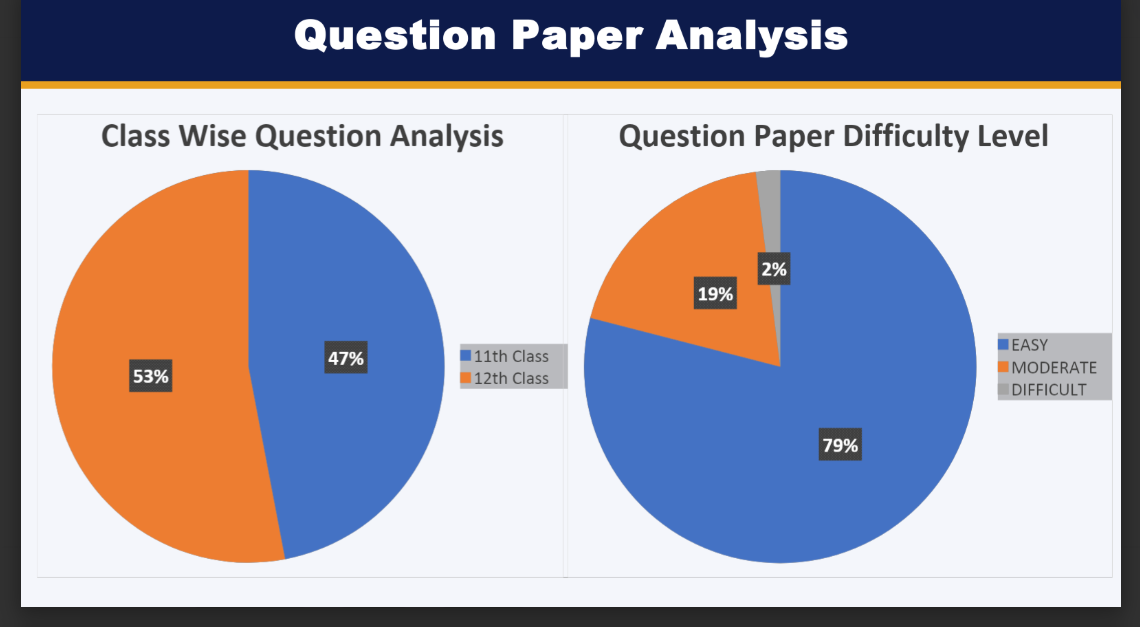
The Re-NEET UG Exam 2026 was conducted on June 21, 2026. The exam was conducted in offline mode, where over 23 lakh candidates appeared. This year, the Re-NEET UG Paper 2026 was of a moderate to slightly difficult level. The physics section was moderate to difficult, chemistry was moderate, and biology was easy to moderate. Top institutes like Matrix NEET Division, ALLEN Career Institute, and Aakash Institutes are widely known as the best NEET coaching centres in India, providing detailed NEET June 2026 Paper analysis to help candidates make scoring strategies for the exam.
As we know, in such intense competition, analysing the Re NEET paper has become equally critical. These institutes not only give you complete data-driven insights but also exam-oriented strategies for the best outcomes on the exam. In this blog, we are providing you with the top as well as the best coaching centres for Re NEET UG 2026 paper analysis, comparison of which is best, and others.
Why Re NEET 2026 Paper Analysis Matters?
NEET is renowned for repeating its concepts and patterns. Skipping the analysis of the Re NEET 2026 paper is akin to navigating without a map. When you analyse the Re NEET 2026 paper in detail, it helps you understand the nature of the examination, how it has evolved over the years, and where you currently stand. A proper analysis of the Re NEET paper also reveals which topics carried the highest weightage, as well as the specific topics on which you spent the majority of your time.
Key reasons to analyse the Re NEET 2026 Papers:
- It gives you a comprehensive way to identify weaknesses and trends to improve your performance for the upcoming exam.
- The best coaching for the Re NEET 2026 paper analysis, refine your exam strategy and improve speed, reducing stress for the actual exam.
- A Re NEET Paper Analysis reveals changing patterns as seen in physics and chemistry.
- A proper analysis of the Re NEET Exam paper improves accuracy, boosts your confidence and highlights common and avoidable mistakes in the real exam.
- It also gives you a perfect understanding of the expected difficulty level that affects the final cutoffs.
How to Choose the Right Coaching for Re NEET 2026 Paper Analysis?
There are multiple NEET coaching institutes in India, and not every institute gives you a quality paper analysis for Re NEET 2026. Top institutes like Matrix Academy focus not only on teaching but also on providing you with detailed performance analytics and exam insights. The following are the main factors you should evaluate while choosing the right coaching for Re NEET 2026 analysis.
- Faculty Expertise & Proven Track Record
- Detailed Performance Analysis that highlights your strengths and weak areas.
- Quality of study material & test series that simulate the real exam, such as those mentioned for NEET by Matrix Academy.
- Doubt Solving Mechanism & Mentorship that ensures you don’t get stuck on difficult concepts.
- Batch Size & personal attention that focuses on individual student progress.
- The mode of coaching should be based on your comfort and needs.
Best Coaching for Detailed Re NEET UG Exam Paper Analysis 2026
The best coaching for Re NEET 2026 paper analysis includes features like structured test series, detailed feedback system, and accurate difficulty simulation. Top institutes offer in-depth, subject-wise, question-level insights and also analyse good attempts, the difficulty level of the exam paper, and immediately predict the expected cutoffs after the exam.
Matrix NEET Division in Sikar (Top Recommendation)
One of the most reliable and affordable coaching institutes in Sikar, Matrix NEET Division in Sikar, is highly recommended by students for Re NEET 2026 preparation. The Matrix Sikar is for you if you want a strong test series plus discipline and can handle a competitive environment. The institute is known for its student-focused approach, structured academic planning, and deep and practical Re NEET paper analysis as mentioned below.
Key highlights of Matrix Academy’s NEET 2026 Analysis & Strategy:
- Structured Practice & Analysis: This includes 50+ mock tests, 12 full revision tests, and 14-unit tests. MAT Lab is also used to identify a knowledge gap.
- Study Material: This includes a 25-book module set with 4650+ MCQs, 1200+ previous-year questions, and NCERT-based content.
- Daily Routine: This emphasises 90 minutes, 870+ offline sessions.
- Doubt Clearance: It provides you with regular, dedicated doubt counters and interactive sessions with faculty, supplemented by the MAT lab.
- Strategy Focus: This recommends daily 3-hour (2 PM to 5 PM) practice sessions to align with the actual exam timing, focusing on scanning the paper.
ALLEN Career Institute
ALLEN Career Institute is also known for producing top NEET rankers every year. It is also known for its comprehensive Re NEET 2026 paper analysis system, which provides insights on difficulty level, high-yield topics and expected cut-off marks to help candidates to evaluate their performance.
Key Highlights of ALLEN’s Re NEET 2026 Paper Analysis:
- Fastest Paper Solution: ALLEN provides a quick and accurate answer key, typically available on their YouTube channel and website.
- Subject-wise Breakdown: The Re NEET 2026 paper analysis breaks down the physics, chemistry, and biology (zoology & botany) sections, detailing the most weightage topics.
- Rank Predictor: It has a specialised tool to predict their rank based on their exam performance.
- Expert Faculty Insights: The experienced faculty provide improvement tips and analyse the NTA exam trends.
Aakash Institute
Aakash is known as Aakash BYJU’s, famous for its structured learning approach and well-designed test series, closely monitoring the Re NEET exam pattern and analysing the Re NEET 2026 paper immediately after the exam with subject-wise breakdown, answer key solution and expected cutoffs. The discussion of the Re NEET 2026 paper analysis, typically on their YouTube channel, helps students gauge their performance.
Key highlights of Aakash’s Re NEET 2026 Paper Analysis:
- Immediate Post-Exam Analysis: Immediately after the exam is concluded, they start discussion and analysis of the paper live on their YouTube channel.
- Expert Review: A subject expert team analyses the Re NEET 2026 paper and provides insights into the difficulty level and identifies tricky questions.
- Answer Key & Solution: After the exam, a detailed solution with an unofficial answer key/ provisional answer key for all paper sets is provided to students to analyse their performance.
Which is Better? Expert Faculty vs AI-Based Re NEET Paper Analysis
Nowadays, NEET coaching institutes are using AI-based tools for Re NEET 2026 paper analysis, which study a large set of questions, identify patterns, generate tests and give performance insights quickly and at scale. The NEET 2026 re-exam paper analysis by expert faculty gives you a comprehensive result based on their year of teaching, exam trends, and students’ performance. The following table includes 5 points through which you can easily differentiate “which is better”.
| S.No. | Basis | Expert Faculty | AI-Based Analysis |
| 1 | Exam Understanding | Strong intuition of NEET trends and NTA mindset from experience | Pattern recognition from large datasets of previous papers |
| 2 | Question Quality | Highly NEET-relevant, conceptually accurate, and exam-like | Fast generation, but sometimes uneven or less realistic |
| 3 | Feedback Speed | Slower, depends on manual evaluation | Instant scoring and performance analysis |
| 4 | Personalization | Based on teacher observation and interaction | Highly data-driven, tracks weak areas precisely |
| 5 | Final Exam Relevance | Very close to real NEET difficulty and pattern | Good for practice, but may not always match the real exam tone |
Re NEET 2026 Paper Difficulty Level Analysis by Coaching Institutes
As per the trends, the exam would have a moderately tough difficulty level by high scoring NCERT based questions. The analytical questions may be time-consuming.
As per the coaching experts, the exam is expected to be statement-based and assertion-reason questions, where the physics and biology sections demand higher conceptual clarity than in previous years. The paper would be challenging, requiring fast calculation speeds to manage time. The chemistry section would be slightly balanced with inorganic, organic, and physical chemistry.
Section-wise NEET 2026 Paper Analysis (Physics, Chemistry, Biology)
The Re NEET 2026 exam was moderate to tough overall. The biology section was the easiest, and physics was slightly tougher. The chemistry section was high-yield, NCERT-based questions requiring a strong reaction mechanism.
Re NEET 2026 Physics Section Analysis (45 Questions, 180 Marks):
The difficulty level of the physics section was moderate to tough due to formula-based, tricky questions. The section pattern was a mix of theoretical and conceptual problems where high-weightage topics were from Electrodynamics, Mechanics, and Modern Physics, electronics and EM waves.
| Class Level | Chapter Name | Number of Questions | Dominant Topic & Nature of Questions |
| Class 11 | Units & Measurements | 2 | Dimensional analysis & Error calculation |
| Class 11 | Kinematics (Motion in 1D & 2D) | 1 | Average speed, velocity & vectors |
| Class 11 | Laws of Motion | 1 | Newton’s Laws & Dynamics of circular motion |
| Class 11 | Work, Energy & Power | 1 | Calculation of work done & collisions |
| Class 11 | Rotational Motion & Centre of Mass | 2 | Moment of Inertia calculations (Tricky) |
| Class 11 | Gravitation | 2 | Kepler’s Laws & Escape velocity |
| Class 11 | Mechanical Properties of Fluids | 3 | Bernoulli’s Principle & Viscosity |
| Class 11 | Thermal Properties & Thermodynamics | 2 | Thermodynamic processes & Specific Heat |
| Class 11 | Kinetic Theory of Gases | 2 | Mean free path calculations |
| Class 11 | Oscillations & Waves | 3 | SHM velocity/acceleration & standing waves |
| Class 12 | Electrostatics & Capacitance | 4 | Potential distribution & Energy stored in a capacitor |
| Class 12 | Current Electricity | 4 | Electrical resistance & Series/Parallel circuits |
| Class 12 | Moving Charges & Magnetism | 2 | Force between parallel currents & Ampere’s Law |
| Class 12 | Magnetism & Matter | 0 | No direct questions asked |
| Class 12 | Electromagnetic Induction & AC | 4 | Faraday’s Law, Lenz’s Law & LCR circuits |
| Class 12 | Electromagnetic Waves | 2 | EM Spectrum characteristics |
| Class 12 | Ray Optics & Optical Instruments | 2 | Refraction through lenses & Lens combinations |
| Class 12 | Wave Optics | 1 | Interference & Wave nature |
| Class 12 | Dual Nature of Radiation & Matter | 3 | Photoelectric effect & Einstein’s equation |
| Class 12 | Atoms & Nuclei | 4 | Bohr model, Radioactivity & Rutherford scattering |
| Class 12 | Semiconductor Electronics | 2 | P-N junction diodes & Logic gates |
| Total | All Chapters | 50 (Attempt 45) | Moderate to Hard overall |
Re NEET 2026 Chemistry Section Analysis (45 Questions, 180 Marks):
The chemistry section was of an easy to moderate overall difficulty level with a balanced pattern. The complexity of the questions was from organic chemistry. The high-weightage topics were from Inorganic chemistry, Physical chemistry, and Organic chemistry. The breakdown is as follows.
- Inorganic Chemistry: Direct NCERT-based questions about Chemical bonding and coordination compounds.
- Physical Chemistry: Thermodynamics and Equilibrium.
- Organic Chemistry: Aldehydes, Ketones, and Carboxylic.
| Class | Branch | Chapter Name | Number of Questions | Question Nature & Dominant Sub-Topics |
| Class 11 | Physical | Some Basic Concepts of Chemistry | 2 | Stoichiometry & molarity calculations |
| Class 11 | Physical | Structure of an Atom | 2 | Quantum numbers & Bohr’s radius trends |
| Class 11 | Physical | Thermodynamics | 2 | Enthalpy change & Gibbs free energy criteria |
| Class 11 | Physical | Equilibrium | 4 | $K_p$/$K_c$ calculations, pH of buffer solutions |
| Class 11 | Inorganic | Chemical Bonding & Molecular Structure | 3 | Hybridisation, Dipole moment & Molecular Orbital theory |
| Class 11 | Inorganic | Classification of Elements & Periodicity | 1 | Electron gain enthalpy & ionic radii trends |
| Class 11 | Inorganic | The p-Block Elements (Class 11) | 1 | Anomalous properties of Boron/Carbon family |
| Class 11 | Organic | GOC: Basic Principles & Techniques | 4 | Isomerism, hyperconjugation stability, and IUPAC |
| Class 11 | Organic | Hydrocarbons | 2 | Ozonolysis reactions & electrophilic addition |
| Class 12 | Physical | Solutions | 2 | Vant Hoff factor ($i$) & elevation in boiling point |
| Class 12 | Physical | Electrochemistry | 2 | Nernst equation application & Kohlrausch’s law |
| Class 12 | Physical | Chemical Kinetics | 3 | First-order half-life & Arrhenius equation graphs |
| Class 12 | Inorganic | The d- and f-Block Elements | 2 | Lanthanoid contraction & $KMnO_4$/$K_2Cr_2O_7$ reactions |
| Class 12 | Inorganic | Coordination Compounds | 4 | CFT splitting, magnetic moments & IUPAC naming |
| Class 12 | Inorganic | The p-Block Elements (Class 12) | 1 | Xenon fluorides structures & oxoacids of Sulfur |
| Class 12 | Organic | Haloalkanes and Haloarenes | 1 | $S_N1$ vs $S_N2$ reactivity mechanisms |
| Class 12 | Organic | Alcohols, Phenols and Ethers | 2 | Lucas test & Williamson ether synthesis |
| Class 12 | Organic | Aldehydes, Ketones & Carboxylic Acids | 1 | Named reactions (Aldol/Cannizzaro) |
| Class 12 | Organic | Amines | 3 | Hoffmann Bromamide & basic strength comparison |
| Class 12 | Organic | Biomolecules | 1 | Reducing sugars & peptide linkage structures |
| Class 12 | Practical | Principles of Qualitative Analysis | 1 | Functional group identification & salt analysis tests |
| Total | – | All Chapters | 45 | Highly Conceptual & Deeply Calculative |
NEET 2026 Biology Section Analysis:
The overall difficulty level of this section was moderate, and this is the most scoring subject in NEET, with questions heavily based on NCERT. The breakdown of high-weightage topics from the chapters is as follows.
- Genetics & Evolution: This is very important, and around 25% of the questions were from this chapter, especially the Molecular basis of inheritance.
- Human Physiology & Plant Physiology: These were also very scoring in Zoology, covering around 40-45% each.
- Ecology: 15-16% dominated by this chapter.
- Biotechnology & Molecular Biology: This topic was high scoring due to the high density of questions.
- Reproduction: This covers both flowering plants and humans, which seems to be marked questions from the topic.
| Unit / Domain | Core Chapters / Topics Tested | Number of Questions | Difficulty Level |
| From Class 11 | |||
| Human Physiology | Digestion, Respiration (RQ calculations), Circulation, Nervous Control | 13 | Easy to Moderate |
| Cell Structure & Function | Cell Theory, Organelles, Mitosis/Meiosis (Prophase-I stages) | 10 | Easy |
| Plant Physiology | Photosynthesis, Respiration, Plant Growth (Phytohormones) | 11 | Moderate |
| Plant & Animal Diversity | Biological Classification, Plant Kingdom, Animal Kingdom traits | 9 | Factual / Easy |
| Structural Organisation | Structural tissues, Morphology of Flowering Plants | 9 | Easy (Anatomy had 0 Qs) |
| From Class 12 | |||
| Genetics & Molecular Biology | Inheritance laws, DNA Replication, Transcription, Lac Operon | 11 | Moderate / Conceptual |
| Biotechnology | Principles, Processes, Vectors, Recombinant DNA Applications | 11 | Moderate |
| Ecology & Environment | Ecosystem dynamics, Population attributes, Biodiversity trends | 7 | Lengthy Statements |
| Reproduction | Sexual Reproduction in Plants, Human Reproduction mechanisms | 5 | Tricky (Hormonal Traps) |
| Biology in Human Welfare | Microbes in welfare, Human health, and common diseases | 4 | Direct NCERT |
Rank Predictor & Cut-Off Analysis for Re-NEET 2026
With the intense competition, Re NEET 2026 cutoffs are likely to stay high, where general category candidates can expect their qualifying score between 720 and 135, while reserved category candidates’ qualifying score may range between 135 and 105. The following table shows the expected Re NEET 2026 cutoff marks.
| Category | All India Quota (AIQ) | State Quota | AIIMS Institutes |
|---|---|---|---|
| General/UR | 615 – 630+ | 590 – 610+ | 700 – 715+ |
| OBC-NCL | 595 – 610+ | 580 – 600+ | 690 – 705+ |
| EWS | 590 – 610+ | 575 – 595+ | 690 – 700+ |
| SC | 520 – 540+ | 480 – 520+ | 650 – 670+ |
| ST | 490 – 510+ | 420 – 480+ | 630 – 650+ |
Mistakes to Avoid While Re-NEET 2026 Paper Analysis
The Re NEET 2026 paper analysis acts like a mirror that reflects your strengths and weak areas in the exam. It does not exactly show where you stand, but it also improves your accuracy, speed, and decision-making for the upcoming exam. So when you analyse the Re NEET 2026 question paper, keep the following things in mind.
| Point | What to Keep in Mind |
| Be Honest with Your Attempt | Don’t justify wrong answers or lucky guesses while reviewing. Mark each question honestly to understand your real accuracy level. |
| Track the Source of Errors | Identify the exact reason behind each mistake. Knowing whether it’s conceptual or careless helps you fix it properly. |
| Link Back to NCERT | Most questions are based on NCERT concepts. Tracing them improves precision and exam-focused study. |
| Analyse Time Management | Review how much time you spent on each section. Fixing poor time distribution can boost your score significantly. |
| Review Attempt Strategy | Check if you attempted easy questions first or got stuck on tough ones. A smart attempt order can improve overall performance. |
| Maintain an Error Notebook | Write down mistakes along with correct concepts and methods. Revising this regularly prevents repeating errors. |
| Focus on Easy & Moderate Questions | In NEET, most questions are easy to moderate. Accuracy here matters more than solving very difficult ones. |
| Look for Patterns in Mistakes | Analyse multiple papers to identify repeated mistakes. This helps you focus on weak areas more effectively. |
| Take Action After Analysis | Don’t stop at analysis; revise weak topics and practice similar questions for the upcoming exam. |
Conclusion
Re NEET is one of the most competitive exams for medical aspirants to ensure their admission to top medical colleges across India. The Re-NEET 2026 exam was conducted on June 21, 2026, and it is important to analyse the Re NEET UG Paper 2026 to evaluate your performance and define where you stand among all.
When it comes to the best coaching for Re NEET 2026 paper analysis, Matrix Academy is one name that is truly recommended by students because of their experienced faculty team, analysis every part of the question paper and give a deep, researched solution to understand better.
Frequently Asked Questions
Due to rising competition, we can say that the exam was challenging.
NTA will soon release the official data, including the top AIR 1 for NEET 2026, on its official website.
The NEET paper analysis gives you an expected idea to estimate your score, predict your rank, and expect the cutoff range.
The overall paper difficulty level of NEET 2026 was moderate to slightly difficult, where the physics section was challenging with moderate overall difficulty but relatively straightforward.
According to the trends, the NEET 2025 paper was reported to be much tougher than the previous one.
The physics section in NEET 2026 was considered challenging, with a mix of conceptual understanding, focusing heavily on mechanics, electromagnetism, modern physics, and optics.
Based on the prediction, chemistry was considered easy to moderate, with a strong focus on the NCERT concept. Physical chemistry was easy, while Organic Chemistry questions were a bit tricky
The biology section was the easiest of all. Some questions made it somewhat challenging for the examinees, such as multi-statement questions, assertion-reason questions, and column-matching questions.