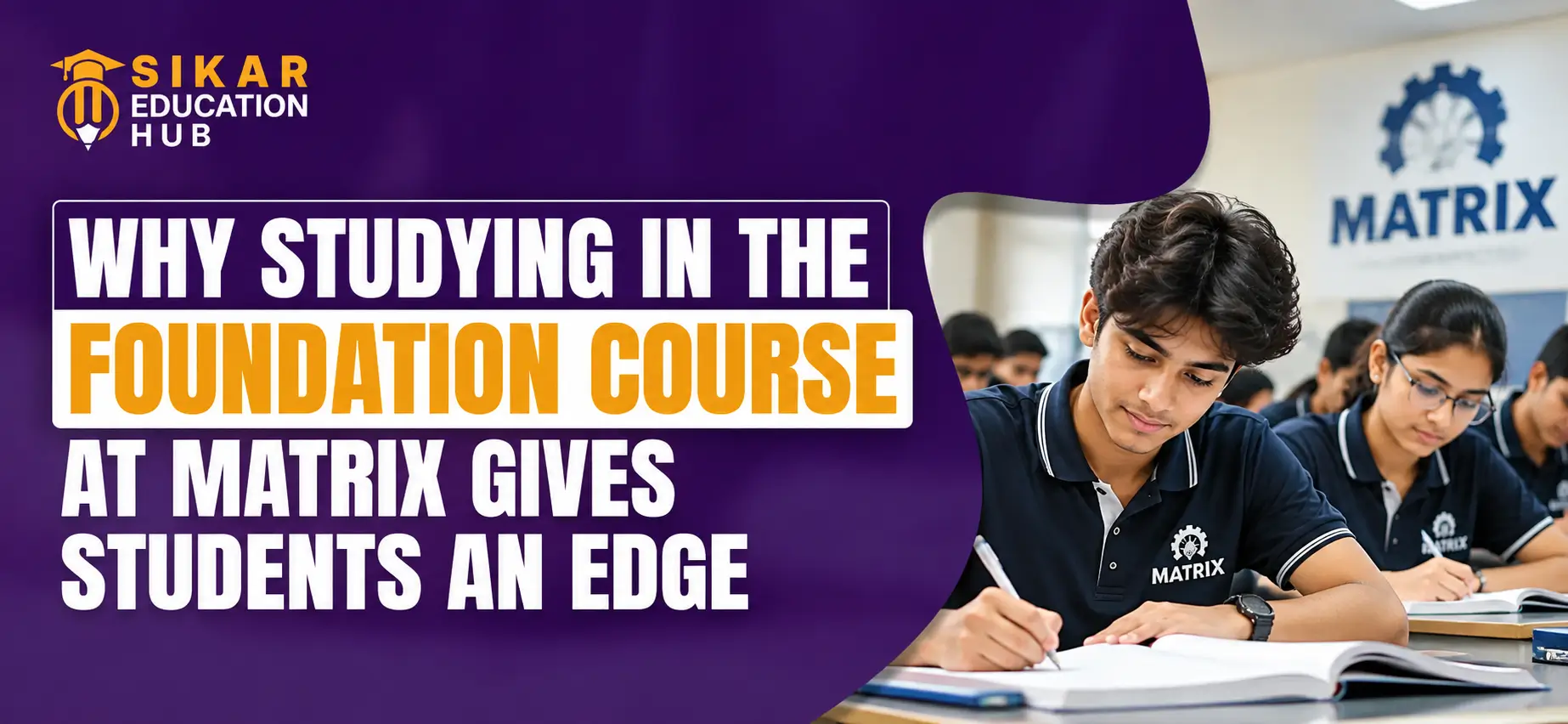
You are in Class 8 or 9, or your child is, and the advice keeps changing: start early for NEET and JEE, or wait till Class 11. This blog answers one question: why studying in the Foundation course at Matrix gives students an edge.
Here is the short answer. Finishing Class 11 topics early does not give you the edge. Clear concepts before Class 11 do, along with regular tests and the habit of solving problems instead of memorising answers. Effort still decides the result, and no course can promise you a seat, so we will also show you who can safely skip a Foundation course.
What does the Foundation course at Matrix cover?
The Edge Foundation programme covers your full school syllabus for Class 6 to 10. On top of that, it adds Olympiad and competitive-exam concepts in Maths, Physics, Chemistry, Biology and Mental Ability.
Matrix teaches the Edge Foundation programme in English and follows the NCERT curriculum. The course runs for 10 to 12 months in a year. You get printed study material, doubt-solving sessions, three labs (Science, Maths and Robotics), and free access to the Matrix learning app. Hostel and scholarship options are also there if you need them.
Matrix also lists CUET, NDA and CLAT among the future exams, so the effort stays useful if your goal changes. You can hear the programme explained in this Matrix video with Anupam Sir. If you compare each pre-foundation course in Sikar, ask for sample study material during counselling and judge its level yourself.
Table of Contents
ToggleWhere does the edge really come from?
The edge comes from three habits the programme builds early: learning concepts before Class 11, testing often, and solving problems in more than one way. Each one has an honest limit.
1. Concepts before Class 11
The NEET (UG) 2026 syllabus and the JEE Main 2026 Paper 1 syllabus both start with basic topics. Physics and Measurement, Some Basic Concepts in Chemistry, and Sets, Relations and Functions come first. Matrix’s own Class 11 JEE programme also assumes you already know Physics, Chemistry and Maths up to Class 10, so strong Class 9 and 10 basics make the first months of Class 11 easier. But basics do not replace Class 11 and 12 study, and you still finish the full syllabus.
2. Regular tests
Matrix gives you class tests, plus BRPTs (Board Readiness Preparation Tests) and CAPTs (Competitive Aptitude Preparation Tests) at regular intervals. So you find your weak chapter in Class 8, not in a Class 12 mock test, and you get used to exam-style questions slowly. But a test helps only if you study your mistakes afterwards. Marks alone teach you nothing.
3. Problem-solving practice
Competitive-exam questions can ask you to apply an idea in a new setting, so regular practice from Class 7 makes such questions familiar sooner. Matrix builds that practice through printed modules with practice questions, Olympiad-style concepts, and lab work. Even then, too much Olympiad work can pull down your school marks, so keep your board results first.
| From Matrix classrooms Kanak Kumari joined Matrix High School in Class 7. Through its foundation programme, she qualified for the Indian National Physics Olympiad (INPhO) and the Regional Mathematical Olympiad (RMO) in 2024. She then scored 99.925 percentile in JEE Main 2025 and AIR 517 (All India Rank) in JEE Advanced 2025. Deepak started at Matrix in Class 8 and took admission in IIT Kanpur after 99.98 percentile in JEE Main 2024. Two stories do not prove a rule. |
The parents of Navya Rao, a Class 8 student at Matrix High School, praise its “specific orientation towards prestigious competitive exams from middle schooling.”
What do Foundation students actually sit?
Foundation students mostly sit school-level talent exams and Olympiads, and Matrix High School students posted these recent results.
| Exam | Matrix High School result |
| STSE (State Talent Search Examination, Rajasthan) | 10 students in the state top 10 (2025-26) |
| IOQM (Indian Olympiad Qualifier in Mathematics) | 15 students moved to RMO Stage 2 (2025) |
| INMO (Indian National Mathematics Olympiad) | 4 students qualified (2023 and 2025) |
These results come from students across classes, so they show the school’s overall record, not the Foundation course alone.
How much does the Foundation course cost?
For 2026-27, Matrix lists city campus Foundation fees from ₹68,000 in Class 6 to ₹92,000 in Class 10. Residential campus fees run from ₹99,000 to ₹1,14,000.
| Class | City campus | Residential campus |
| Class 6 | ₹68,000 | ₹99,000 |
| Class 7 | ₹72,000 | ₹99,000 |
| Class 8 | ₹75,000 | ₹99,000 |
| Class 9 | ₹85,000 | ₹1,08,000 |
| Class 10 | ₹92,000 | ₹1,14,000 |
These amounts are for Matrix’s N and E batches, so ask the counsellor what each batch means before you pay. Matrix gives books, study material and the summer uniform at no extra charge. New students pay a one-time registration fee of ₹5,000 that Matrix does not refund, and the winter uniform costs ₹4,500 extra. The scholarship test costs ₹300, and the scholarship page explains the rest.
Which class should you start in?
If you want the most time, start in Class 6 to 8. If you want a shorter, focused course, join in Class 9 or 10. Wait for Class 11 only if you can work harder in a shorter window.
An earlier start means more years of fees, so choose by interest, school load and budget.
| Point | Foundation course (Class 6 to 10) | Starting in Class 11 |
| Time for concepts | Several years at a slow pace | Two years for the full syllabus |
| Pressure | Spread across many years | Packed into Class 11 and 12 |
| Cost | You pay for the extra years | You pay for fewer years |
| When not to choose it | Skip it if you already feel tired of studying, if the fee strains your family, or if your interest has not started yet | Skip a late start if your Class 10 basics are weak and you have no plan to fix them |
You do not need Class 6 either. Mayank Soni joined Matrix in Class 10 and scored a perfect 100 percentile in JEE Main 2023. A Foundation course gives you time. It does not use that time for you. So the real question is “Will I use the extra time well?”
What should you ask any Sikar institute?
Ask five things before you pay: teachers, tests, doubts, fees and stay.
• Teachers: Does a separate faculty teach Foundation classes, or the same teachers as Class 11 and 12?
• Tests: How often do tests happen, and does someone explain your mistakes?
• Doubts: When can your child meet a teacher, and for how many hours a week?
• Fees: What do registration, uniform and study material add to the listed fee?
• Stay: How far is the campus, and what does the hostel cost?
What should you do next?
You started with a worry: start now, or wait till Class 11? Here is the plain answer. The Foundation course at Matrix gives you time, regular tests and problem-solving practice before the demanding years begin. That is the edge, and it only works if you use it. If your child likes Maths and Science and the fee fits your budget, Foundation is a sensible start. If not, Class 10 and Class 11 are still open. No pressure, no fear, just a clear plan.
Tomorrow, do one thing. Note your weakest school subject, then call the Matrix counselling line on +91-1572-241911 and ask how the programme handles it. Ask for the current batch dates too. You can also download the Matrix brochure and read it before the call.
FAQs
No. Both exams test a full syllabus, so you still need complete preparation in Class 11 and 12. Foundation only gives you a stronger start.
Matrix teaches the school curriculum inside the programme and lists sports and extra-curricular activities in its calendar. Even so, watch your child’s stress and sleep, and cut extra practice if school marks drop.
Yes. A Class 11 start needs a strict routine and honest work on any weak Class 10 topics. Foundation gives more time, but it is not compulsory.
Matrix gives scholarships through more than one route, including the Matrix Scholarship and Admission Test (M-SAT) and performance in the Matrix Olympiad. You can qualify through any route, but Matrix awards only the highest scholarship that applies. Ask the counsellor which routes apply to your child’s class, and read the scholarship page for current benefits.
Matrix says it offers flexible installment plans, and it shares the schedule during registration. So ask for the dates and amounts before you pay the first installment.
For 2026-27, Matrix follows a refund policy with set timelines and deductions, and the Admission Kit fee is non-refundable. Read the full refund policy on the fee page before you pay, so you know what you get back if plans change.
Matrix runs its own Olympiad, and its 2025-26 results cover students from Class 1 to 12. The 2026-27 edition launched in June 2026, and your performance in it can count towards a scholarship. Check the Matrix Olympiad site for current registration details.